
The hip joint is a ball and socket joint designed for optimal balance between inherent bony stability and excellent functional range of motion. Variation from normal morphology can lead to instability in the form of dysplasia or decreased range of motion in the form of femoroacetabular impingement. Both can lead to premature osteoarthritis based on the severity of the abnormalities and the person's activity level. Radiographic abnormalities of one part of the joint can be adequately compensated by a variation in another part, avoiding arthritis. Occasionally the hip can show signs of both dysplasia and impingement at the same time.
Standard Radiograph of the Hip
Antero-Posterior View
Evaluation of the entire pelvis is necessary when evaluating either hip joint — for individual analysis as well as comparison to the opposite side.
A standard pelvis X-ray is performed in the supine position with pelvic tilt and rotation controlled to obtain consistent images across patients.
Neutral rotation — the central sacral line and the tip of the coccyx should align with the symphysis pubis. The two obturator foramina should appear symmetrical.
Neutral tilt — the distance between the sacrococcygeal junction and the superior end of the symphysis should be 2–3 cm in males and 2–6 cm in females.
If the distal femoral rotation is controlled by keeping the patella perfectly anterior, the femoral version will be reflected on the film and the apparent neck-shaft angle may be an overestimate. If the hips are held in internal rotation to bring both trochanters parallel to the floor, the neck-shaft angle measurement will be more accurate.
Lateral Views
- False profile lateral – shows anterior acetabular coverage of the femoral head. Allows measurement of the anterior center-edge angle and shows anterior subluxation during weight bearing. Only one hip can be studied at a time. A good AP pelvis will often show anterior coverage adequately.
- Frog lateral – both hips are held in flexion and maximal abduction and external rotation. Pelvic tilt is not controlled and the acetabulae cannot be analysed well. As both hips are visible, range of motion can be compared. In hips with good motion, the visible anterior head-neck junction may be antero-inferior and may miss the cam deformity.
- Shoot-through lateral / long neck lateral in 15° of internal rotation – shows only one hip but demonstrates the cam deformity better and gives clues to femoral version.
- Dunn lateral in 45° of flexion, maximal abduction, and neutral rotation – shows both hips for comparison, demonstrates the antero-superior head-neck junction well, and gives a good estimate of femoral version.
Acetabular Parameters
Teardrop
The teardrop is a radiographic condensation of the innominate bone at the inferior end of the acetabulum. A normal teardrop is U-shaped. The medial border is continuous with the ilio-ischial line (Kohler's line) and the lateral wall is continuous superiorly with the floor of the acetabulum.
The width of the teardrop varies with rotation of the pelvis. A wide teardrop is associated with a shallow acetabulum. A very narrow teardrop — where the medial and lateral walls touch or cross each other at the floor — is a sign of deeper than normal acetabulum (coxa profunda), causing over-coverage of the head.
Sourcil
The sourcil is the radio-dense subchondral bone of the weight-bearing dome of the acetabulum. The lateral edge should be differentiated from any extra-articular ilium that gives a false estimate of head coverage.
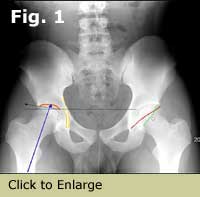
Size — the sourcil normally extends laterally to cover about 80% of the width of the femoral head. This coverage can also be measured by the lateral center-edge angle of Wiberg (normal 25–30°).
Slope — a straight line from the medial edge of the sourcil to its lateral edge should be horizontal or up to 10° superior to the line connecting the inferior edges of the two sourcils (Tönnis angle 0–10°). This maintains joint reaction forces perpendicular to the slope of the sourcil, minimising shear stress.
An increase in the up-slope of the sourcil induces lateral subluxation of the femoral head, initially resisted by the labrum and capsule. These structures react with hypertrophy but ultimately the labrum fails with degeneration, allowing lateral subluxation in dysplasia.
A down-sloping sourcil induces medial translation of the head and loading of the acetabular fossa and fovea, resulting in medial osteoarthritis with well-maintained superior joint space.
Acetabular Version
The normal acetabulum is anteverted by approximately 20°. The anterior wall is always more horizontal and extends towards the pubis; the posterior wall is more vertical and extends to the ischium. In the normal anteverted acetabulum, the anterior and posterior walls meet at the lateral edge of the sourcil and should not cross.
The posterior wall typically passes through the centre of the femoral head. If it passes lateral to the centre, posterior coverage is excessive. If it passes medial to the centre (posterior wall sign), posterior coverage is deficient.
A very medial anterior wall that barely covers the head suggests deficiency of anterior coverage. Anterior over-coverage is suggested by crossover of the anterior wall over a normal posterior wall. True retroversion should have posterior under-coverage along with the crossover sign — the lower the crossover occurs, the more significant the anterior over-coverage.
Appearance of the ischial spine on a good AP view is a sign of acetabular retroversion.
- Subchondral cysts can develop from rim loading in dysplasia and after advanced cam impingement damage
- Osteophytes of the acetabular rim can develop from an ossified labrum in pincer impingement
- Os acetabulare and rim fractures can occur from rim loading in dysplasia and from impingement
Femoral Parameters
Shape of the Head
The femoral head is close to a sphere. Loss of sphericity by flattening, or overgrowth of the epiphysis onto the neck, produces a misshapen head that may not be congruous within the acetabulum. Sphericity may be measured objectively using Mose circles.
The sagging rope sign on the AP view shows abnormal extension of the head onto the neck.
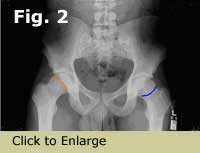
Coxa magna (large head) is not problematic if it is well contained and congruous in the acetabulum.
Physeal Scar
The location of the physis can be seen even after physeal closure. Superolateral extension of the physeal scar with extension of the epiphysis onto the superior neck is typical of the cam deformity, which appears like a bicycle helmet on the lateral view performed at the appropriate rotation.
Fovea Centralis
The fovea is a depression in the femoral head for the attachment of ligamentum teres, located medially and inferiorly. It does not contact the sourcil. Articular cartilage inferior to the fovea is thinner with less surface area than that superior to it.
A superiorly placed fovea coming in contact with the sourcil is abnormal — called caput valgum or fovea alta.
Effective Articular Surface
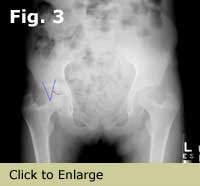
The area of contact between the articular cartilage of the head and the sourcil can be measured by an angle between a line from the centre of the head to the upper edge of the fovea or the medial edge of the sourcil (whichever is more superior), and a line from the centre of the head to the lateral edge of the sourcil. This area should be large without causing impingement.
Femoral Neck
The function of the femoral neck is to provide a lever arm for the abductor muscles and to provide adequate clearance around the head for normal range of motion.
Neck-shaft angle — normal 125–130°. Internally rotating the hips until the neck is horizontal to the floor shows the true angle; any external rotation of the femur will increase this value.
- Coxa valga — increases abductor resting length but decreases abductor lever arm, resulting in increased joint reaction forces
- Coxa vara — decreases abductor resting length, causes abductor fatigue and Trendelenburg gait, decreases joint reaction forces by increasing the abductor lever arm
- Coxa breva (short neck) — decreases both abductor resting length and lever arm, increases joint reaction forces, causes abductor fatigue and Trendelenburg gait
Trochanteric height — the tip of the trochanter lies at the level of the centre of the femoral head. In coxa vara it is superior to the centre; in coxa valga it is inferior. This relationship is minimally affected by hip rotation.
Femoral Version
Version of the femur is the angle between the femoral condylar axis and the femoral head-neck axis. Normal version is approximately 20° of anteversion (internal torsion of the condyles relative to the head-neck axis). With SCFE, the head tilt deformity changes this axis.
Lateral Offset / Articulotrochanteric Distance
The distance between the centre of the head and the tip of the trochanter on the horizontal plane represents the abductor lever arm — normally 2 times the diameter of the head. Lateral offset is inversely proportional to joint reaction forces in the hip.
Head-Neck Offset — Alpha Angle
A narrow neck relative to a larger head maintains good range of motion. A narrow neck around a spherical head allows motion until the acetabular labrum contacts the femoral neck at its maximal concavity. The most common area of impingement is the anterior femoral neck.
The alpha angle is the angle between the neck axis and the line connecting the centre of the head to the point at which head sphericity ends. The normal alpha angle is about 45°; a higher angle implies less motion before impingement occurs.
A herniation pit occurs at the site of impingement on the femoral neck.
Congruity of the Hip
The articular surfaces of the femoral head and acetabulum are normally parallel at the dome. Lateral subluxation causes the joint space to appear wider medially.
Medial space — distance between the femoral head and Kohler's line is normally 10–15 mm. Increased space is seen in dysplasia and lateral subluxation. Decreased space is seen with coxa profunda; the head touches or crosses Kohler's line in true protrusio acetabulae.
Shenton's line — indicates continuation of the superior obturator foramen with the inferior femoral head and neck. Superior and lateral subluxation is suggested by a break in Shenton's line. Excessive external rotation of a normal hip can break Shenton's line without true subluxation.
Summary — Radiographic Differentiation
These numbers are basic differentiators of individual hip parameters. Occasionally a hip can have certain parameters of FAI and others suggesting dysplasia, making clinical examination essential.
| Parameter | Dysplasia | Normal | Anterior FAI |
|---|---|---|---|
| Teardrop | Wide | Narrow 'U' | Crossover |
| % Coverage | <70% | 80% | >90% |
| CE angle | <20° | 25–30° | >35° |
| Tönnis angle | >10° | 0–10° | <0° |
| Acetabular Version | ↑ anteversion | Normal | Retroversion |
| Anterior wall | Deficient | Normal | Crossover |
| Posterior wall | Normal / ↑ | Normal | Normal / deficient |
| Femoral Version | >30° | 20° | <10° |
| McKibbin Index | >40° | 30–40° | <30° |
| Fovea | Alta | Normal | Normal |
| Neck-shaft angle | Valgus | Normal | Varus |
| Alpha angle | 45° | 45° | >50° |
| Medial space | >15 mm | 10–15 mm | 10–15 mm |
| Shenton's line | Disrupted | Intact | Intact |