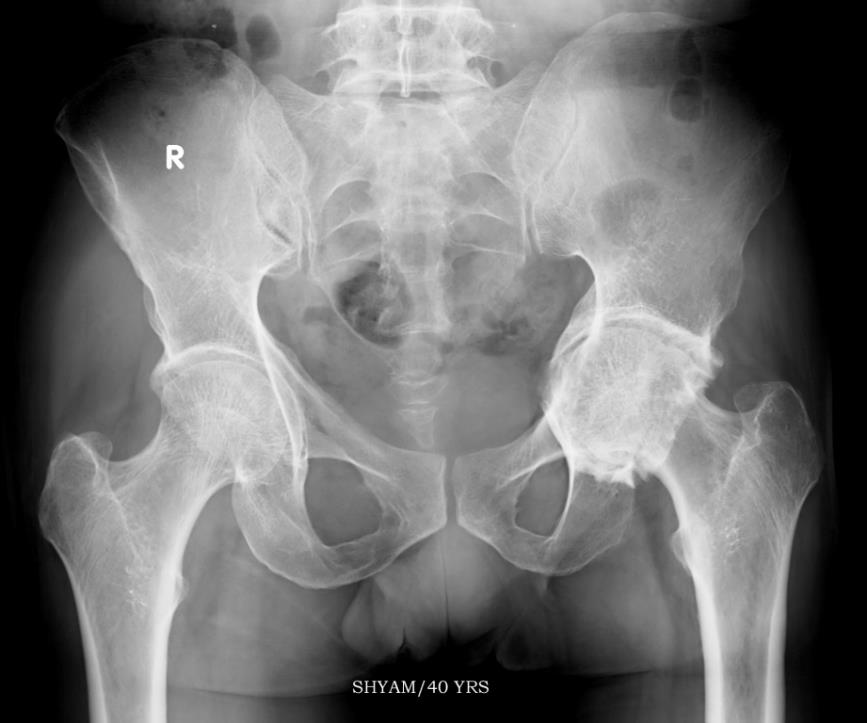
Protrusio acetabuli is a developmental anomaly with a deep socket in which the femoral head crosses the ilio-ischial line. It can develop with rickets, osteogenesis imperfecta, and juvenile rheumatoid arthritis, but most protrusio is idiopathic.
Protrusio with Normal Medial Coverage
Protrusio with normal medial coverage (MCE ≥25°) and a flat sourcil angle typically causes pincer-type impingement and develops arthritis by 40 years of age. Treatment before arthritis sets in can involve extensive acetabular rim trimming to improve range of motion.
Protrusio with Medial Dysplasia
Protrusio with medial dysplasia / high acetabular fossa (MCE <20°) and a negative sourcil angle causes medial osteoarthritis from foveal loading on the acetabular fossa, combined with pincer impingement from acetabular over-coverage. Treatment before arthritis sets in is a reverse periacetabular osteotomy to flatten the sourcil and improve medial coverage. This treatment also requires antero-inferior rim trimming to reduce the prominence of the inferior acetabulum resulting from medial rotation of the acetabular fragment.
Key Principle
Any amount of valgus cannot compensate for a significantly negative sourcil — just as any amount of varus cannot compensate for severe acetabular dysplasia.