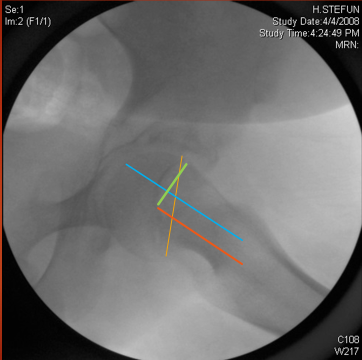
Slipped Capital Femoral Epiphysis (SCFE) is a well-known hip disorder in older children and adolescents. The femoral head (ball) slips through its growth cartilage and settles at an angle to the neck and shaft.
The majority of slips occur in obese children without any other abnormality. A few patients may have hormonal disorders, renal disease, or rickets.
Pain and limp are the most common complaints. The pain may be mild and felt in the hip, thigh, or knee, leading to delayed diagnosis. Children may remain active with some pain, suggesting a stable slip. Untreated, the slip is likely to progress gradually or suddenly.
Unstable Slip
Sudden severe pain with inability to walk even on crutches suggests an unstable slip, which carries higher complication rates and poorer results.
Patients can also present with a fused slip causing pain and deformity after growth plate closure — these patients need treatment only for the residual deformity.
The diagnosis is usually suggested by clinical exam and confirmed by plain X-rays. A stable slip is not immediately dangerous and has few complications as long as it does not become unstable. An unstable slip can result in loss of blood supply to the femoral head and lead to arthritis. Both stable and unstable slips alter the shape of the femoral head and limit hip motion. Severe slips are well known to lead to arthritis, and even mild cases can cause joint damage long term.
Dr. Gourineni's FIR-Based Classification
Dr. Prasad Gourineni uses internal rotation at 90° of flexion (FIR) as a measure of the severity of anterior FAI in SCFE. It takes into account slip morphology along with femoral antetorsion and acetabular morphology. Synovitis and pain influence the examination — FIR under anaesthesia is more reliable.
| Type | FIR Criteria | Treatment |
|---|---|---|
| Type 1 | FIR >10° | In-situ screw fixation only |
| Type 2 | FIR <10° but correctable with osteoplasty | Screw fixation and arthroscopic osteoplasty |
| Type 3 | FIR cannot be restored to 10° with osteoplasty alone | Corrective osteotomy required |
10° was chosen as adequate FIR in SCFE children because they are typically obese and less active — allowing natural remodelling of a small neck bump to gain a few more degrees of FIR is acceptable compared to leaving a larger bump to abrade the labrum and acetabular cartilage. 20° should be the goal for active children.
Surgical Options
In-Situ Screw Fixation
A simple, quick procedure involving a small incision and fixation of the femoral head in its present position with a screw. It reliably prevents progression and has few complications, but the persistent deformity can cause joint damage over time. Dr. Gourineni developed and published on oblique screw fixation and recommends a fully threaded 7.3 mm cannulated screw.
Reshaping of the Head and Neck (Osteoplasty)
The deformity caused by the slip acts as a cam bump, jamming against the acetabulum and labrum and causing damage. This bump can be removed through arthroscopic or limited open technique, but is adequate alone only for mild slips. Dr. Gourineni published on his arthroscopic technique in a large series ahead of most other authors reporting their experience.
Osteotomy
In severe slips, in addition to removing the bump, the head must be reoriented on the femur by separating it from the shaft — an osteotomy. The osteotomy can be done at various levels below the head. The further from the head, the more secondary deformity is created to compensate for the head deformity, though distal osteotomies are considered safer. Dr. Gourineni has extensive experience with femoral neck osteotomy through surgical dislocation for all types of slips and limited experience using the arthroscope.
Femoral Neck Osteotomy with Surgical Dislocation
Safe surgical dislocation of the hip while preserving the blood supply to the femoral head enables procedures once considered unsafe. The femoral head is completely separated from the neck at the deformity, the neck is reshaped, and the head is replaced on the neck correcting the deformity completely.
This procedure involves a large incision, significant blood loss, and requires high technical expertise. Incisions heal quickly in children, blood can be salvaged and returned, and several surgeons have performed it safely. It is more readily accepted in unstable slips due to poor results with other techniques, and has given the best results in Dr. Gourineni's hands for unstable slips and more severe stable or fused slips not correctable with osteoplasty alone.
Complications
General complications from anaesthesia, infection, and healing issues are not entirely within the surgeon's control. In spite of best efforts, avascular necrosis (loss of blood supply to the femoral head) and chondrolysis (deterioration of hip cartilage) can occur rarely after any hip procedure. A child's or caregiver's inability to follow precautions can also lead to poor results.